
Readings:
Ex 20.1-20; Psalm 19; Philippians 3.4-14; Matthew 21.33-46
May the words of my mouth and the meditation of my heart be acceptable in your sight, O Lord, my strength and my redeemer.
“Forgetting what lies behind and straining forward to what lies ahead, I press on towards the goal for the prize of the heavenly call of God in Christ Jesus.”
This past week there’s been a theme of paradox illuminating my meditations. And today it comes together again. As we draw to a close our theme of Living Water with the celebration of the Feast of St Francis, 800 years since his death, I see such richness in the opposites of our life of faith.
Take water for example, water is nourishing, life sustaining. We see the effects of drought, just last night I noticed how what is left of the grass in my backyard crunched under my weight while I took Chewie for a walk.
Water is also mighty and powerful, not one of us is stronger than it even if we have big powerful utes. Water can sweep us away in an instant.
Just as we know the impacts of a lack of water, we also know the impacts of too much water in this country. And then… if there weren’t floods in the top of Qld bringing with it the death of so much animal life… Lake Eyer wouldn’t fill and become the flourishing eco-system that it is for so many birds and fish and amphibians.
Paradox.
I think Francis got that – the knife’s edge of awe and terror – and it led to his complete about-face in life. In fact, as I sit with what Paul wrote in Philippians, it resonates with St Francis’ life.
Paul says, “I regard everything as loss because of the surpassing value of knowing Christ Jesus my Lord. For his sake I have suffered the loss of all things, and I regard them as rubbish, in order that I may gain Christ and be found in him, not having a righteousness of my own that comes from the law, but one that comes through faith in Christ, the righteousness from God based on faith.”
Paul says he suffered the loss – he forfeited – all that he had, his social standing his material possessions. In the end his life.
Francis did the same. When his father dragged him before the bishop of Assisi to complain that Francis was using his funds to rebuild the chapel (he basically stole a bolt of fabric, sold it, and used the proceeds to fund his project), Francis removed all his clothes (that which officially belonged to his father) and declared that he had no father but God in heaven. He disinherited himself, and rejected all worldly possessions. He left that place in only a cloak given to him by the bishop.
Now… imagine witnessing that! Imagine the fortitude it would take for a 20-something year old to disown their father and the wealth that comes with the family association, imagine regarding that as something to be discarded, as dung, for the sake of Jesus.
Can you? I mean… I’m struggling!
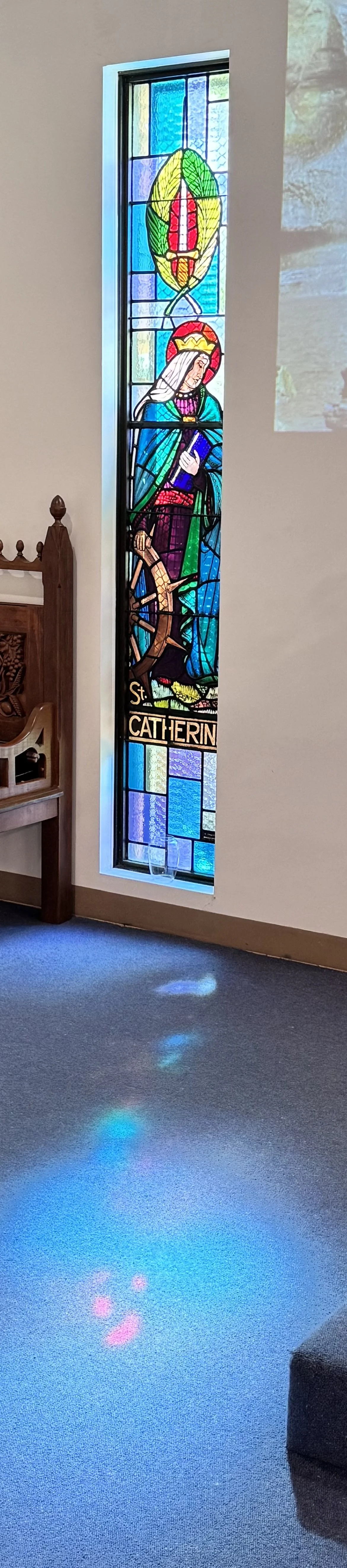
This is why Francis is a saint, a hero of the church. Through his life, we see the light of Christ shine. It’s why we make images of them in stained glass, so the sun can illuminate their stories and we can see Christ shining through their lives that little bit easier.
After that embodied statement of casting off all that came before and focussing on Christ, Francis went to work with ‘lepers’. He never owned anything again. In the early days he was basically homeless, and when he became a leader of friars, they began staying at church properties, and later still, purpose-built friaries were made but owned by the church or other benefactors.
But can you imagine this 20-something year old upstart who’s publicly rejected his family in such a humiliating way, who’s now homeless and probably a bit smelly, walking through those doors? Could we listen to him? Or will he have crossed too many social norms and been deemed as rude and impolite, therefore we turn our backs to what he has to say?
What if it were the Apostle Paul? Imprisoned several times, once the orchestrator of putting our friends to death by stoning… what if he walked through those doors? Could we listen to him, the one who regards his life before Christ as dung?
What kind of welcome can we offer to so many people of faith? Our saints are eccentric to say the least!
What would our advice be to St Catherine? It’s the emperor who wants to marry you, sure he’s already married, and a murderer, but for your own sake, just do it! For our sake! You’re bringing your family’s name into disrepute and danger. If you hadn’t been so difficult earlier and just chosen to be married to Jesus and someone else, then you wouldn’t be in this position now.”
We have a tendency to make fairy tales out of our saints, even out of God, Jesus, and the Holy Spirit. We make them lovey-dovey. And I know that I preach the love of God all the time! Love can be paradoxical, especially when it comes to God.
How do we love God in such a way that leads us to regard everything else as dung? As refuse which can only be discarded lest it make us sick?
This is what St Paul and St Francis had in common.
St Francis lived the paradox of the abundant life in Christ whilst taking a vow of absolute poverty, so that he could give himself completely to Christ’s call in him.
And now 800 years after his death, there are around 660,000 people worldwide who call themselves Franciscans, and many, many more who see Christ’s light shining through his story.
Let us end with a medieval prayer, prayed by St Francis, which illustrates the paradoxical love of God.
May the power of your love, Lord Christ,
fiery and sweet as honey,
so absorb our hearts
as to withdraw them from all that is under heaven.
Grant that we may be ready
to die for love of your love,
as you died for love of our love. Amen.
- The Absorbeat, prayed by St Francis, likely of earlier origin.