
Readings: Is 58.1-12; Ps 112.1-10; 1 Cor 2.1-16; Mt 5.13-20
May I speak in the name of God; always creating, redeeming, and sanctifying.
Why do we gather for worship?
What difference does it make to you?
Personally?
As a household?
To us as a community?
How often do you, we, think about God, when we’ve finished singing the last hymn on Sunday?
How does our worship affect our choices in life, both personally and communally?
Which way round is our worship?
a) worship first then action out of discernment, or
b) desire for specific action leading to worship?
One of the things that made worshipping other gods desirable in ancient times (and even today) is that they were able to be manipulated. If you just gave them what they wanted – this sacrifice, that work – you could bend the god to your own will. We see this creep in to the story of the Israelites (and indeed of Christianity) and the consequences are dire.
This is the trap of justification by works – if only I do [these things] in [this way] then God will do [this] for me.
That is not how our God works. It’s how we work. We believe that if we do XYZ then we should get this particular reward.
This thinking leads to questions like, “Why do bad things happen to good people?” As though their works should exempt them from the hardships of being human; as though particular people do deserve bad things happening to them.
This thinking leads to beliefs like Karma which has specific teaching in eastern religions and which westerners have shrunk to mean simply that “you get back what you put out,” which a) simply isn’t true, and b) unburdens us from the need for grace and forgiveness.
We are justified by Grace alone, and yet the prophets, the apostle Paul, and Jesus himself are agreed that right worship leads to specific actions.
Right worship reorders our life: our personal life and our communal life. Because worship is EVERYTHING we do! How we spend our time when we leave this place will reveal what we truly worship.
This is God’s criticism of the Israelites made through Isaiah: they went into exile because they did not know God, did not behave as God demands, and were unfaithful in their worship. They cried out in exile, God answered; they seemed to have understood and changed; and now, they’re back in Jerusalem and have immediately forgotten!
Their worship is hollow, its manipulative, and un-transformative. They make the right sacrifices, they fast, they put on sackcloth and lie in ashes… they ‘delight’ to know God’s ways… but it does not change their ways. Isaiah 58.3-4: Look, you serve your own interests on your fast day and oppress all your workers. You fast only to quarrel and to fight and to strike out with a wicked fist.
God does not want our performance!
Worship should never be performative.
Worship needs to come from the heart, in gratitude, and with an openness to be transformed by God’s own unfathomable grace.
Will we allow ourselves to be transformed by the words of the prophet?
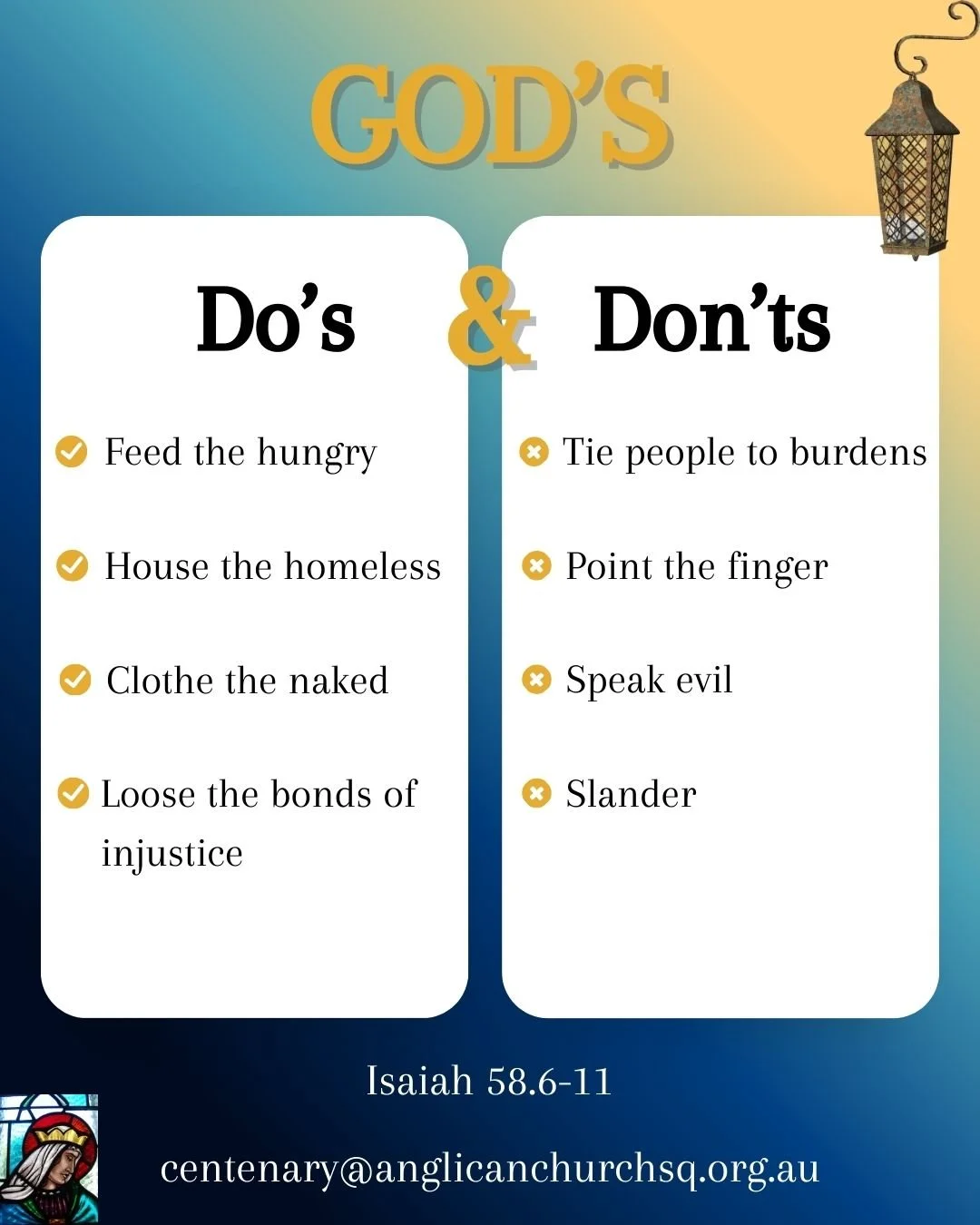
“6 Is not this the fast that I choose: to loose the bonds of injustice, to undo the thongs of the yoke, to let the oppressed go free, and to break every yoke?
7 Is it not to share your bread with the hungry, and bring the homeless poor into your house; when you see the naked, to cover them, and not to hide yourself from your own kin?
8 Then your light shall break forth like the dawn, and your healing shall spring up quickly; your vindicator shall go before you, the glory of the Lord shall be your rearguard.
9 Then you shall call, and the Lord will answer; you shall cry for help, and he will say, Here I am. If you remove the yoke from among you, the pointing of the finger, the speaking of evil,
10 if you offer your food to the hungry and satisfy the needs of the afflicted, then your light shall rise in the darkness and your gloom be like the noonday.
11 The Lord will guide you continually, and satisfy your needs in parched places, and make your bones strong; and you shall be like a watered garden, like a spring of water, whose waters never fail. ”
Jesus says he has not come to abolish the Law, but to fulfil it. Jesus fulfils the Law by infusing it with Grace, so that the rigidity that comes with all laws is softened so that they more rightly reflect the will of God.
We are in the throws of preparing for two important times in the life of the church:
Lent
AGM: Budget
Lent is a time traditionally associated with fasting. We do not fast for ourselves; we do not fast to induce suffering upon ourselves; we fast to release resources to refocus our heads, hearts, and hands to Gods. The resources that are released by our fasting are to be given to God’s work: feeding the hungry; housing the homeless; clothing the naked.
Our budget is lean this year. Possibly the leanest you’ve had. And, I wonder what it might be like if we throw the wisdom of this world to the wind, and stepped wholeheartedly, in faith, into the foolishness of God…
Can we throw everything we have at the bonds of injustice?
Can we, as people who are working towards the realisation of God’s kingdom here on earth, throw caution to the wind, and give everything we have to feeding people, housing people, clothing people, to removing our desire to point fingers and place blame, to removing all slander and evil words from our midst?
God is very clear: it is in these ways that we become the light, as though it was the breaking of dawn. It is in these ways that our darkest days will be bright as the noonday sun. Because we choose to worship God with every fibre of our being and every resource we have.
Paul says, “I came to you in weakness and in fear and in much trembling. My speech and my proclamation were not with plausible words of wisdom but with a demonstration of the Spirit and of power, so that your faith might rest not on human wisdom but on the power of God. (1 Cor 2.3-5)
Let us step out in faith and be a light to the world.
Amen.