
Readings:
Exodus 17.1-7; Psalm 95.1-11; Romans 5.1-11; John 4.5-42
May the meditations of my heart and the words of my mouth be acceptable to you, O Lord, my Rock and my Redeemer. Amen.
Please be comfortable.
What a wonderful reading we have for International Women’s Day. Jesus and the Samaritan woman at the well.
I love John’s motif of water throughout his gospel. It became a very important part of my spirituality after travelling to Israel and noticing the effort that was put in to securing water.
From Hezekiah’s tunnel, the 530m tunnel built to secure the Gihon spring for Jerusalem before the Assyrian siege. They started from both ends and somehow met in the middle with only a 30 cm difference in height!
To Herod the Great’s palace at Masada and the engineering that was conducted throughout the valley to collect the rainwater and direct it into the cisterns. Fascinating!
To the pictographs in Wadi Rum, Jordan, likely indicating directions to the nearest spring.
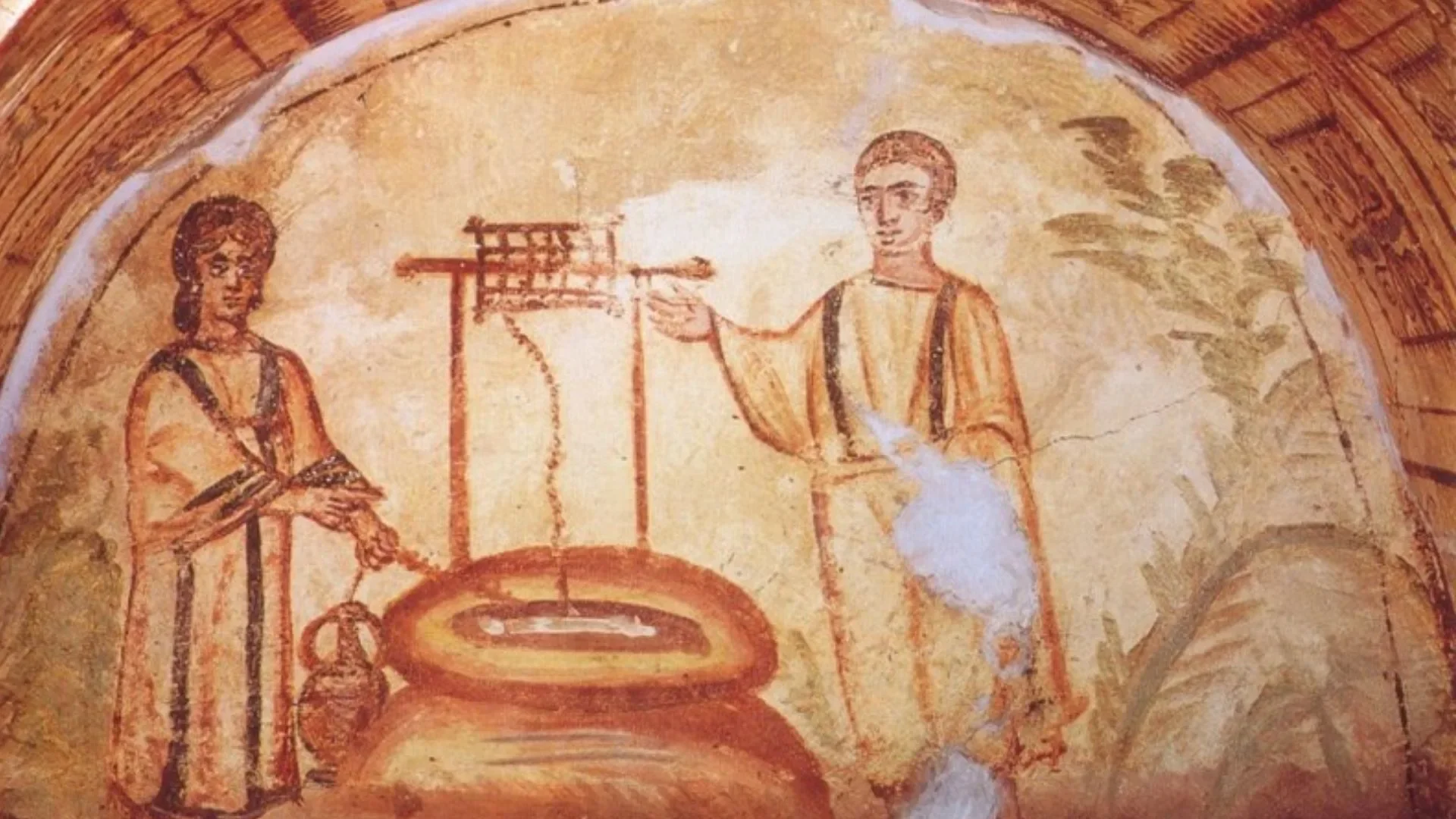
So much effort was put into finding and securing water. Which is why Jacob’s well was so important. It isn’t only because the tradition tells us that it was dug by Jacob, grandson of Abraham, but because it is fed by a spring. It is fed by living water.
Thirst is both a physical and spiritual need. Our physical needs, those indicated by the base level on Maslow’s hierarchy of needs, are spiritual.
We see this all through Exodus:
The people are oppressed in their slavery… they need their God.
The people are hungry… they need their God.
The people are thirsty… they need their God.
I love that the spring that God provides the Israelites with is called, Massah and Meribah: Tested and Quarrelled. Because it is also the place that God stood before Moses and provided them all with life-saving water. It is the place where their thirst is quenched by God’s presence even in their quarrelling and testing. And I don’t know about you, but I think I would become quite quarrelsome if I was starving for water.
God doesn’t abandon us to our quarrelling, to our testing, nor to our thirst.
Instead, God meets us in it.
Not only that, Jesus joins us in our physical thirst!
Jesus is “tired out” by his journey and sits at the well, which makes sense if you are thirsty, but is difficult when you have no bucket. But at least you know someone will come along eventually.
The woman that Jesus meets at the well is a Samaritan. This shouldn’t be a surprise to the reader as we’ve just been told that Jesus is in Samaria! In fact, in the verse preceding our reading today, John says that Jesus “had to go through Samaria.”
He didn’t. Not literally. Most Jews would go around not through Samaria, even though it was the fastest route north, because as we know, they were not friends.
But Jesus “had” to go through Samaria because even though salvation comes from the Jews, salvation is for the whole world, and so he offers it first to their cousins, the Samaritans, and through a Samaritan woman.
There are so many reasons why Jesus “shouldn’t” be speaking to this woman, especially when they’re alone. And, just to be clear, even today if I was alone in the desert and had a strange man speaking to me, I would probably feel a little on edge. I don’t think we give her enough credit for staying there and holding enough space for the theological conversation to emerge. That conversation was significant enough of an event that the woman calls out Jesus’ action, and the disciples themselves are “amazed” that it is happening.
This woman is in every way Nicodemus’s opposite.
Man/woman
Jew/Samaritan
Night/day
Learned/unlearned
Cannot understand/can and does understand
Leaves the conversation/Leaves her water jug
She is the first apostle in the gospel of John, and through her a whole city comes to faith. Jesus is willing to sit with her and explain. Jesus identifies himself as the Messiah to her first. He does not order her not to tell anyone, as he’s reported to do elsewhere in the gospels.
She is the first person to reap a harvest! And she does so by leaving her water jug behind. This symbolism is perfect! When you have the living water that Jesus offers, you thirst no more. She has no need for the water jug anymore, because she has Jesus’ words. He says, ‘The water that I will give will become in them a spring of water gushing up to eternal life.’ She is the spring.
So far, we’ve looked at this from a spiritual angle, because for us water security isn’t an issue, but I do want for a minute to apply this in a literal way.
Water security is a fundamental need of humanity. Women, children, and people who live with disabilities are by far the most impacted by water insecurity.
War is the single most preventable cause of water insecurity. Water has been used as a military tool, either by restricting access, or flooding. It has been used as a weapon. And it sources have been fought over for millennia. A Unicef report in 2021 says that “lack of clean water is far deadlier than violence in war-torn countries.”
Water insecurity puts women and girls at far greater risk for a number of reasons: it is usually women and girls who collect the water; they are made to walk greater and greater distances to collect the water, putting them at risk of attack; girls are often taken out of education in order to collect the water; sanitation is reduced because of the scarcity which means women and girls cannot properly care for themselves during menstruation and leaves them vulnerable to infection; pregnant and breastfeeding women are more likely to suffer from dehydration than others. We can see this beautifully in this artwork, the artist understood this aspect of dehydration.
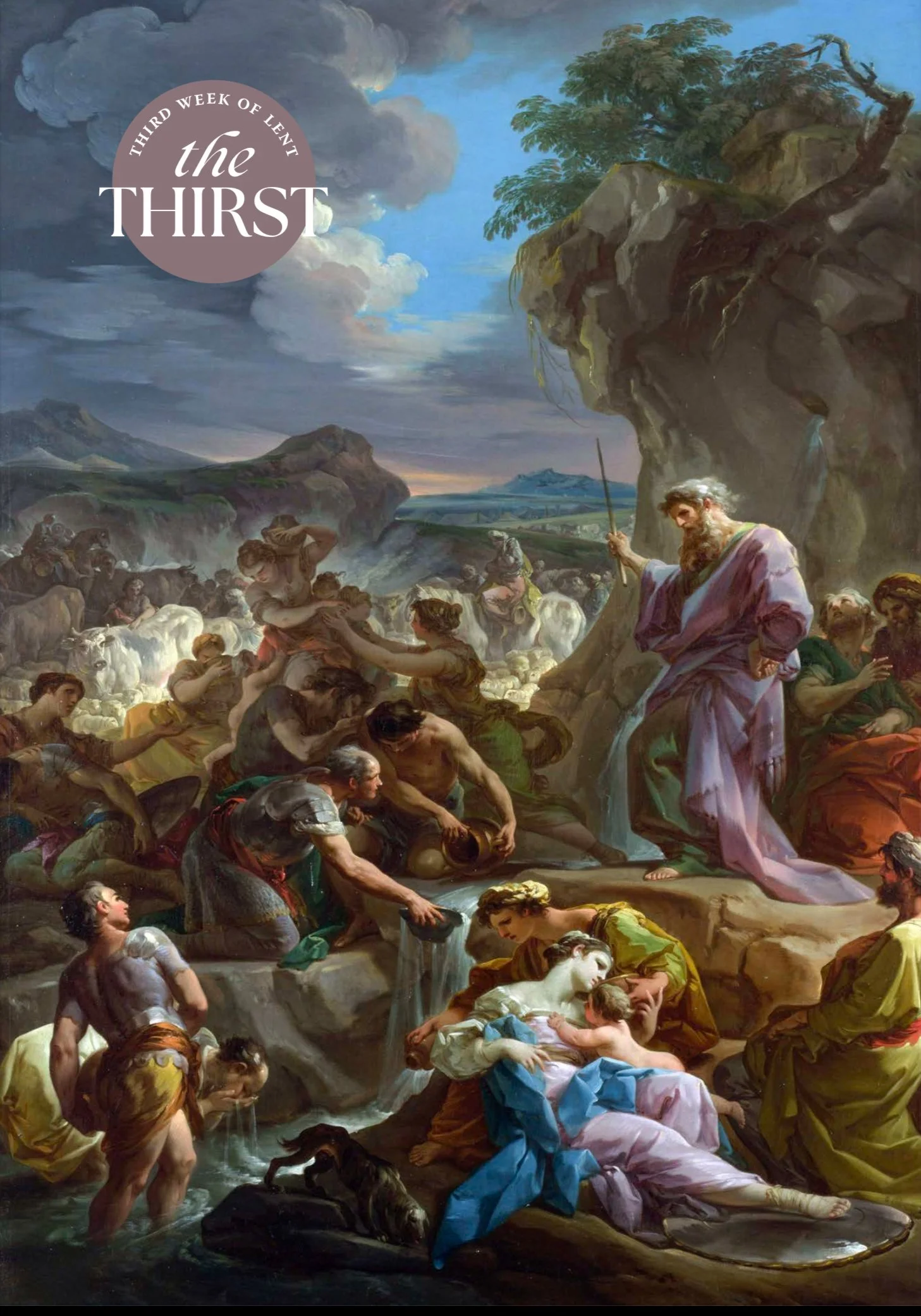
Moses Striking the Rock (c. 1743-1744). Corrado Giaquinto (1703-1766). Oil on canvas, 136.5cm x 95cm. National Gallery, London, UK. Public Domain.
Image from COMPASSIO - Lenten Program 2026, Catholic Diocese of Wollongong, 2026, p.26.
I can imagine these women and girls quarrelling with God. And I can imagine God accepting that quarrel. Do we?
It is fine for us to spiritualise thirst for a theological discussion. It is a great metaphor.
But it’s a great metaphor because of our physical need for water which produces thirst in the first place.
If Jesus joins us in our physical and spiritual thirst, how are we to respond to the physical and spiritual thirst of our neighbours?
In most of the stories of Jesus’ encounters with people, he heals first. He addresses the physical needs first. Our scripture today, doesn’t say whether the woman drew water from the well to give Jesus a drink, but I think she would have. She was his host, after all, as well as his guest.
We too must draw living water, literally and spiritually, for our neighbours so that we may be both host and guest to them.
Amen.